
 RW
Rwanda’s cultural ties with Cambodia take centre stage at Francophonie event
Rwanda’s National Ballet joined Cambodian performers at the opening of the Village de la Francophonie in Phnom Penh (…)

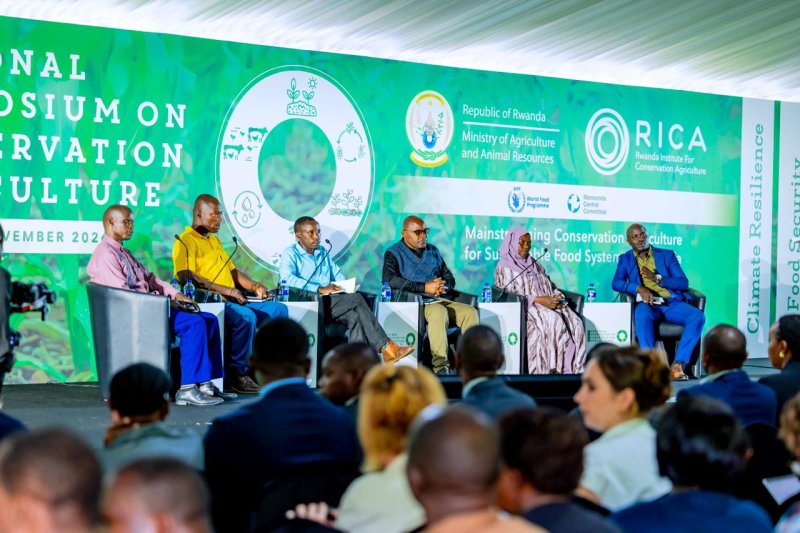
Some Rwandan farmers say they are harvesting significantly more maize and beans after moving away from traditional cultivation methods to conservation agriculture, which involves minimising soil disturbance and protecting the soil surface.
Nyirambonimpa Saidat, a farmer from Kirehe District, said she used to harvest just 30 kilogrammes of maize and 20 kilogrammes of beans from five ares of land before receiving training from the Rwanda Institute for Conservation Agriculture (RICA).
She said the same plot now produces up to 300 kilogrammes of maize and 280 kilogrammes of beans when weather conditions are favourable.
“I used to cultivate five ares and harvest 30 kilogrammes of maize and 20 kilogrammes of beans. After RICA trained me in conservation agriculture, I now harvest up to 300 kilogrammes of maize and 280 kilogrammes of beans from the same area when the weather is favourable,” she said.
Nyirambonimpa explained that the method requires farmers to avoid digging deeply, make planting holes and cover the soil with crop residues. This helps retain moisture, while decomposing plant material adds organic matter to the soil.
Tuyizere Emmanuel, another farmer who received training from RICA, said his maize harvest rose from about 25 kilogrammes to more than 70 kilogrammes per are after adopting the practices, including mulching and applying organic and inorganic fertilisers.
Their experiences were shared at a meeting held at RICA on Thursday, November 12, which brought together about 450 farmers, researchers, government officials, private-sector representatives and development partners to discuss expanding conservation agriculture in Rwanda.
Nteziryayo Ignace, a member of a farmers’ organisation in Rwanda, said the approach had helped improve production but called for increased government investment to support wider adoption.
RICA president Momar Dieng said farmers needed to change practices to address soil degradation, erosion and the effects of climate change.
He cited Rwanda’s 2025 Nationally Determined Contribution, which estimates that more than one million hectares are at high risk of erosion, with an average of 25 tonnes of topsoil lost each year per hectare.
Dieng said conservation agriculture relies on three main principles: reducing soil disturbance, keeping the soil covered and rotating crops. He called for the approach to move beyond pilot projects and become part of wider agricultural programmes, supported by investment, research and farmer training.
State Minister for Agriculture and Animal Resources Dr Olivier Kamana said smallholder farmers needed access to appropriate equipment, inputs, loans, skills and markets if they were to adopt the methods on a larger scale.
He called on government agencies, financial institutions, businesses and development partners to work together to address those needs.
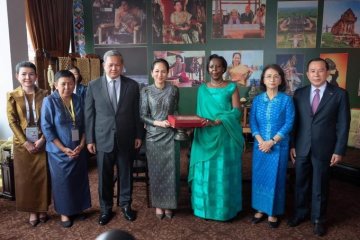
Rwanda’s National Ballet joined Cambodian performers at the opening of the Village de la Francophonie in Phnom Penh (…)

Gospel singer Israel Mbonyi and traditional dance troupe Inganzo Ngari gave audiences an unexpected musical treat at (…)

President Paul Kagame has begun his first state visit to Cambodia with a royal reception in Phnom Penh, as Rwanda (…)
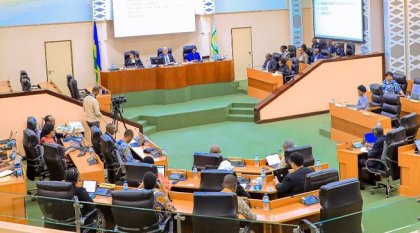
Rwanda’s target of connecting every household to electricity by 2029 has come under scrutiny in the Senate, where a (…)