
 RW
Rwanda calls for stronger African voice in global decision-making
Rwanda’s Foreign Minister Olivier Nduhungirehe has called for greater African influence in international (…)

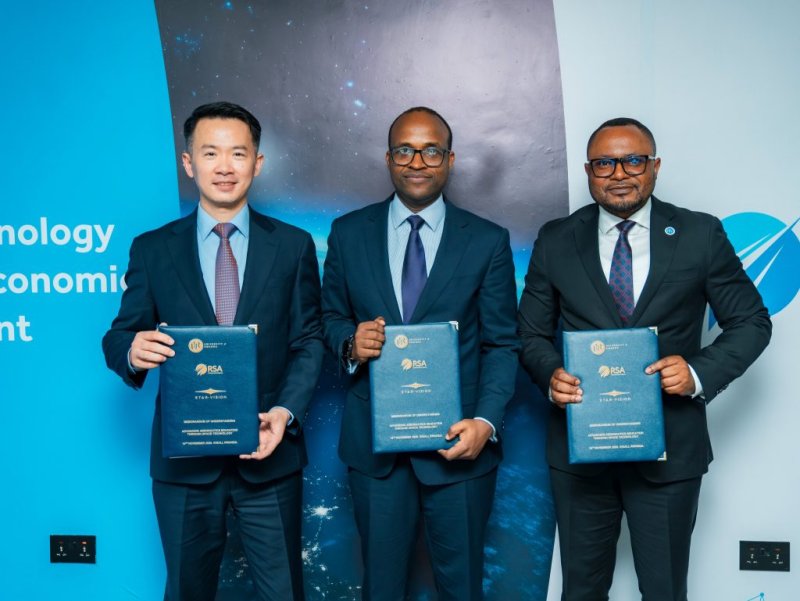
Rwanda has signed a partnership with Chinese space technology company STAR.VISION Aerospace to expand satellite research, strengthen space education and develop artificial intelligence applications that process data while satellites are still in orbit.
The memorandum of understanding was signed on November 19 by the Rwanda Space Agency (RSA), the University of Rwanda and STAR.VISION, a company specialising in satellite technology and artificial intelligence.
The partnership will give Rwandan students, researchers and technical experts access to satellite Earth-observation data, simulation tools, technical training and opportunities for joint research.
One of its main areas of focus is on-orbit artificial intelligence, a technology that enables satellites to analyse information in space instead of transmitting all the raw data to ground stations for processing.
This could help speed up the delivery of useful information for applications such as crop monitoring, mineral exploration, flood surveillance, fire detection and urban planning.
By processing data before it is transmitted to Earth, satellites can send more targeted information to users, potentially reducing the time and resources required to analyse large volumes of imagery.
The Rwanda Space Agency said the collaboration would help build local expertise and strengthen the country’s research capacity by giving students and researchers access to practical space technologies and satellite data.
The agreement also seeks to promote the transfer of knowledge and technology to Rwanda and develop skills among graduates and professionals who could contribute to the country’s growing space sector.
Expanding Rwanda’s space capabilities

The partnership adds to Rwanda’s efforts to develop the infrastructure and expertise needed to make greater use of satellite technology.
The country launched its first satellite, RWASAT-1, in November 2019 in collaboration with Japan. The satellite was designed to support applications including water-resource monitoring and agricultural activities.
The Rwanda Space Agency was established in 2020 to coordinate and develop the country’s space sector and promote the use of space technology in national development.
In June 2026, the agency’s satellite communications facility in Mwulire, Rwamagana District, received Tier 3 certification from the World Teleport Association, becoming the first fully certified teleport in sub-Saharan Africa.
The facility’s capacity to communicate with multiple satellites simultaneously was subsequently expanded in September through the activation of a second antenna.
Rwanda has also sought to widen access to satellite imagery through a partnership with US-based Earth-observation company Planet Labs announced in August 2026. The initiative is intended to make satellite images available to government institutions, universities, technology startups and development partners for uses including agriculture, environmental protection, urban planning and disaster management.
The new partnership with STAR.VISION brings an additional focus on developing the skills and research needed to process and apply satellite data, including through artificial intelligence.

Rwanda’s Foreign Minister Olivier Nduhungirehe has called for greater African influence in international (…)

Rwanda says projects registered between 2020 and 2025 could generate more than 1,000 jobs, as business leaders from (…)

Rwanda and Israel are seeking to expand cooperation in agriculture, technology, education and other development (…)

The war in Ukraine and nuclear arms control featured on the agenda as US President Donald Trump met Chinese (…)